Three Key Takeaways
- Single-source partnership delivers control. Adgo Controls handles custom panel design, in-house build and PLC programming for Modern Ice, eliminating the handoffs that slow most food-processing automation projects.
- One screen, full plant visibility. At a greenfield Myrtle Beach facility, every ice maker, storage system, bagging line and conveyor feeds into a single HMI dashboard with remote access and alarm notifications.
- Food-grade discipline matters. Regulatory scrutiny, sanitation interlocks and contamination controls separate food plant integrators from general industrial shops.
Introduction
If you run a packaged ice plant, a food processing line or any facility under FDA or USDA oversight, you already know that automation is not a nice-to-have. It is the difference between a plant that runs lean overnight and one that pages an operator every two hours. Across every industry Adgo Controls serves, the calculus is the same.
That reality is exactly why Modern Ice, a Cincinnati-based engineering firm that designs and builds packaged ice equipment, has trusted Adgo Controls with the controls side of its plants for roughly a decade.
This case study walks through how the partnership works, what it produced for a recent greenfield project in Myrtle Beach, and what plant operators should look for when evaluating any food processing automation partner.
Why Controls Matter
A controls package that looks good in a spec sheet can fail on the floor. The wrong PLC architecture, a missed sanitation interlock or a poorly designed HMI can cost a plant tens of thousands of dollars per shift in lost throughput, scrap or downtime. In the food and beverage industry, the consequences are sharper. Recalls, regulatory observations and contaminated product are the failure modes no plant manager wants to see on the morning report.
What Is Food Processing Automation?
Food processing automation is the design, integration and programming of control systems that operate the equipment inside a food or beverage plant. That includes PLCs, HMIs, SCADA software, sensors, drives and the network layer that ties them together. Done well, it falls under the broader practice of industrial controls.
In practical terms, food processing automation covers:
- Custom control panels engineered to plant-specific equipment lineups.
- PLC and HMI programming to run that equipment safely and efficiently.
- Process integration across mixers, fillers, freezers, conveyors, baggers and storage.
- Sanitation and washdown protections so controls survive the cleaning environment.
- Remote monitoring, alarming and dashboards so operators can run lights-out shifts.
- Traceability and reporting to satisfy FDA, USDA and FSMA requirements.
The discipline sits at the intersection of industrial automation and food safety regulation, which is why it demands integrators who understand both worlds.
Who Is Modern Ice, and What Does the Partnership Do?
Modern Ice, headquartered in Cincinnati, Ohio, designs and engineers packaged-ice making equipment for production plants across the country. Their customers include large packaged ice producers, such as Home City Ice, that depend on Modern Ice to scope the plant, specify the equipment and coordinate installation.
Adgo Controls handles the controls side. That means designing the control architecture, building the panels through in-house electrical control panel fabrication and programming the PLCs and HMIs that bring every machine in the plant to life.
The relationship has held for nearly 10 years for a simple reason: Modern Ice needed a partner that could handle every layer of the controls package under one roof. Design to spec, build the panels, program the systems and stand behind the result. Adgo does all four.
The Challenge: Why Does a Single-Source Controls Partner Matter?
Modern Ice’s pain points will sound familiar to any plant manager who has tried to coordinate a controls project across multiple vendors.
When the panel designer, the panel builder and the programmer are three different companies, the seams show up early. Wiring labels do not match the program. The HMI screens do not reflect the actual plant layout. Sanitation interlocks get forgotten. Each handoff is a place for the schedule to slip.
In our experience, the cost of stitching multiple vendors together shows up at the worst moments: during factory acceptance testing, commissioning and the first overnight run. The table below maps where issues arise and how a single-source model addresses them.
| Project Element | Multi-Vendor Approach | Single-Source Adgo Model |
|---|---|---|
| Panel design | Outsourced or split across firms | Engineered by the same team that programs it |
| Panel fabrication | Subcontracted; design intent can drift | Built in-house in a UL-certified panel shop |
| PLC and HMI programming | Handed to a third programmer with no design context | Written by the engineer who specified the controls |
| Startup and commissioning | Multiple vendors on site; finger-pointing if something breaks | One team, one accountable owner |
| Ongoing support | Tickets bounce between vendors | One phone number, one service relationship |
Modern Ice wanted to eliminate those handoffs. They needed a partner that could deliver full systems integration under one roof:
- Design custom control panels to the exact spec of each plant
- Build those panels in-house, don’t outsource them
- Program the PLC and HMI so the system operates the way the plant was engineered to run
- Show up at startup and own the result
That is the package Adgo delivers on every project.
The Solution: One Plant, One Screen
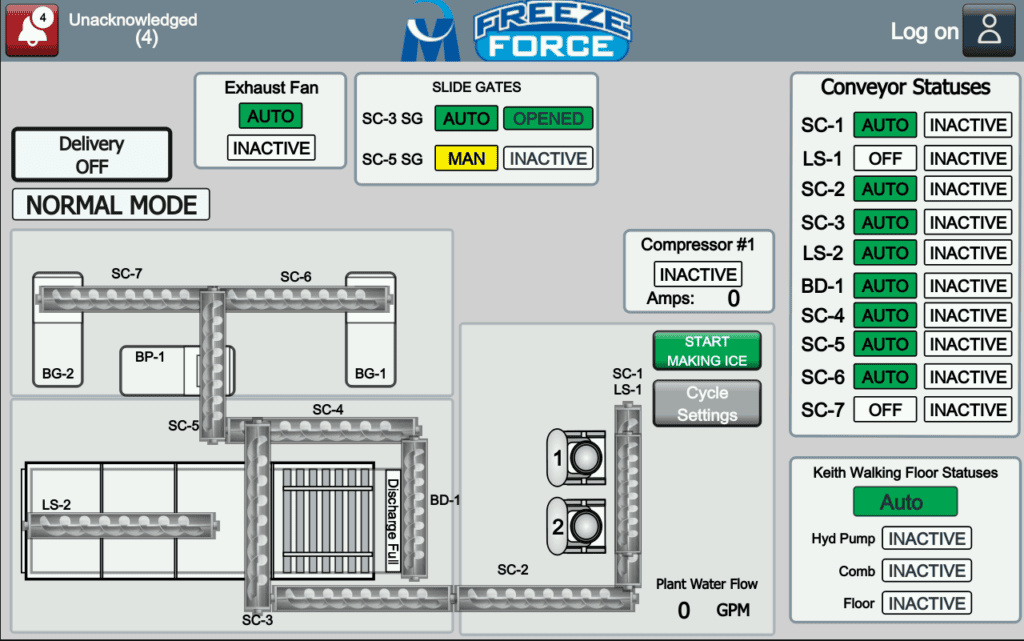
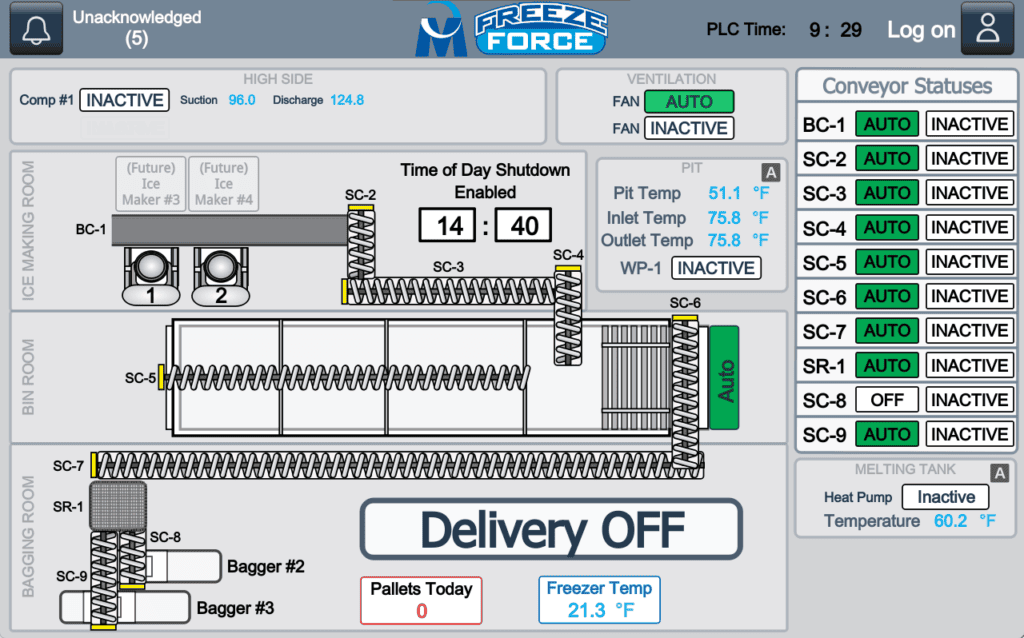
A new packaged ice producer in Myrtle Beach built a greenfield facility from the ground up. The plant houses several ice makers, multiple storage systems, three bagging production lines and a conveyor field that links them. Without a unified control system, an operator would be jumping between half a dozen panels, each from a different OEM, each with its own quirks.
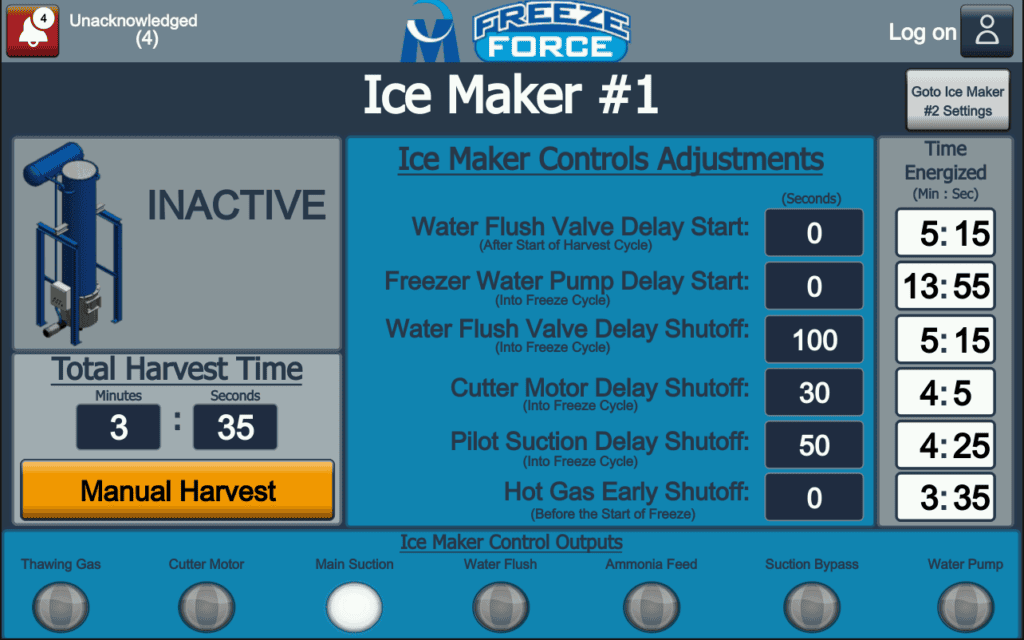
Adgo replaced that complexity with a single integrated control system. From one HMI screen, the operator can monitor and control every aspect of the plant. The dashboards pull live data from the controls Adgo designed and programmed, so there is no translation layer between the equipment and the information.
The system delivers:
- Unified HMI dashboards that show real-time status of ice makers, storage, bagging and conveyors on one screen.
- Remote access so the owner can log in and see the full plant from anywhere.
- Remote alarm notifications that push alerts to operators if any subsystem trips overnight.
- Custom-engineered control panels that were built in-house to the equipment lineup of each specific plant.
- Custom PLC and HMI programming designed for the way the plant actually runs.
Most clients are surprised by how much the remote layer changes their week. With overnight production runs and push notifications, the owner can sleep through a shift and trust that any issue will reach a phone before the plant shuts down.
What Makes Food Processing Automation Different
There is a reason the team at Adgo emphasizes food experience when scoping a new plant. Food processing automation carries a layer of scrutiny that general industrial automation does not.
Food plants answer to federal regulators. FDA, USDA and FSMA each impose standards on how a plant operates, how it is cleaned, how it documents traceability and how it prevents contamination. The standards exist because the products go into the American food supply and everyone wants to avoid sick consumers and recalls.
That regulatory reality shows up in controls work in several ways:
- Equipment specification leans toward washdown-rated, stainless and sanitary-design components.
- Sanitation cycles and interlocks must be hardwired into the program, not bolted on.
- Allergen and lot traceability has to be designed into the data layer from day one.
- Alarms and event logging need to support audit and recall scenarios.
- For refrigeration-heavy plants, ammonia or CO2 safety logic carries life-safety stakes.
We have seen this on retrofit projects where a controls package acceptable for general industrial use suddenly faces a USDA inspector’s standards. A general industrial integrator can miss those requirements. A food-experienced integrator builds them in from the first panel drawing.
What Adgo Does That a Typical Integrator Will Not
The differentiation comes down to scope and accountability. Most controls integrators specialize in one slice of the stack. They design panels and farm out the build, or they program PLCs without owning the hardware, or they install but do not engineer. Adgo runs design, fabrication and programming out of one 30,000-square-foot UL-certified facility.
Adgo holds the full scope. On a Modern Ice project, that means:
- Custom panel design specific to the plant’s equipment lineup.
- In-house panel fabrication.
- PLC and HMI programming written for that exact plant.
- Remote access and notification architecture built into the design.
- Single point of accountability from concept through startup.
When the controls work, the credit is shared. When something needs a tweak at 2 a.m. on a Saturday startup, there is one phone number to call.
The Results
For Modern Ice, the partnership with Adgo has produced positive, repeatable results across the plants the two teams have delivered together. Plant owners running Adgo-controlled facilities consistently see the operational gains that come with single-source automation:
- Confidence to run overnight production with minimal on-site staff
- Single-screen visibility across previously siloed equipment
- Faster issue response thanks to pushed alarm notifications
- Reduced startup friction from one-vendor accountability
- Smoother audits and regulatory inspections from controls designed to food-grade standards
The strongest signal is the repeat work itself. Modern Ice has trusted Adgo with the controls side of plant after plant, year after year. That long-running partnership is the clearest indicator that the model delivers.
The Bottom Line
For Modern Ice, the controls partner is not a line item. It is the difference between a packaged ice plant that runs the way it was engineered to run and one that fights its operators every shift. Adgo Controls has earned a decade of repeat work by treating food processing automation the way regulators do: as a discipline that demands single-source accountability, food-safe design and an HMI that an operator actually wants to use.
If you are building, retrofitting or scoping a food or beverage plant, the controls decision deserves the same scrutiny as the mechanical design. Talk to Adgo Controls about your project, or book a meeting to see what one-screen, one-vendor automation looks like in your facility.